

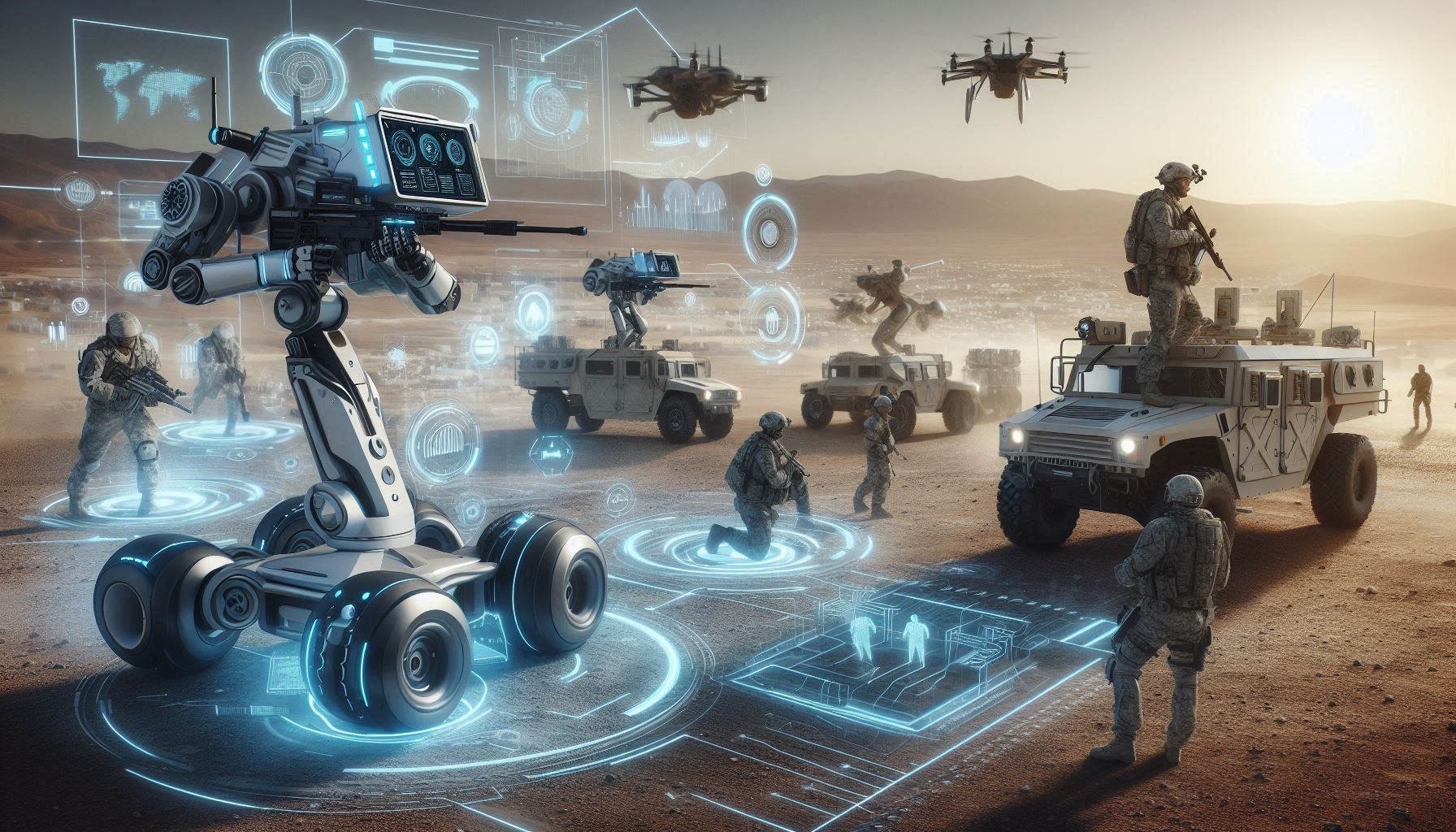

Autonomous ground systems are no longer a concept sitting in defense labs. They are already being deployed, tested, and scaled in real combat environments, reshaping how armies think about risk, movement, and frontline decision-making. What is emerging is not just a new type of vehicle, but a new layer of warfare where machines take on the most dangerous physical roles and humans shift further back into oversight and strategy.
Below is a deep, real-world look at how this shift is unfolding and what it means for the future of military power.
1. Frontline logistics is becoming robotic by default
One of the fastest growing uses of autonomous ground systems is logistics. Armies are using unmanned vehicles to carry ammunition, food, medical supplies, and equipment across active conflict zones where traditional convoys would be exposed to ambush or artillery.
In Ukraine, the use of ground robots for battlefield support has expanded rapidly, with thousands of unmanned ground missions reported in a single quarter of 2026. These systems are increasingly used to evacuate wounded soldiers and deliver supplies under fire, reducing the need for human drivers in exposed positions. This shift is subtle but profound: logistics, once a predictable human-heavy operation, is becoming a robotic supply chain under battlefield conditions.
What matters is not just efficiency. It is survivability. Every autonomous convoy removes human exposure from routes that are often the most lethal part of war.
2. Reconnaissance is moving from “missions” to continuous machine presence
Traditional reconnaissance depended on sending units or drones for specific missions. Autonomous ground systems are changing that into something more persistent.
Modern robotic vehicles can stay in contested areas for long periods, quietly mapping terrain, tracking movement, and feeding continuous intelligence back to command systems. Unlike human patrols, they do not fatigue, lose situational awareness, or require extraction under pressure.
Programs like Europe’s Milrem Robotics Type-X demonstrate how ground robots are being designed not just for transport or combat support, but for persistent battlefield awareness with layered autonomy and remote control fallback.
The real shift is duration. Instead of snapshots of the battlefield, commanders get a living map that updates second by second.
3. Combat support vehicles are evolving into semi-independent systems
The boundary between support and combat is blurring. Autonomous ground systems are increasingly being designed to carry weapons, provide fire support, or act as mobile defense platforms.
Some systems already integrate machine guns, remote weapon stations, or missile payloads, allowing them to engage targets under human authorization or pre-set rules of engagement. The key trend is not full autonomy, but delegated execution. Humans define intent. Machines handle movement, positioning, and timing.
This is especially important in high-intensity environments where seconds matter. A robotic platform can reposition under fire faster than a crewed vehicle, reducing exposure and increasing operational tempo.
At the same time, defense developers are carefully balancing autonomy with control frameworks, keeping humans in the loop for lethal decisions while pushing machines deeper into tactical execution layers.
4. Air-ground robotic teaming is becoming standard architecture
One of the most important developments is not ground robots alone, but how they connect with aerial systems.
New military experiments show ground vehicles coordinating with drones in shared missions. Drones scout ahead, identify threats, and update maps in real time. Ground robots then navigate those environments with pre-fed intelligence and adaptive routing.
This creates a layered intelligence stack:
- Air systems detect and observe
- Ground systems move and act
- AI systems coordinate both in real time
Research in air-ground collaboration shows that robots can now interpret mission instructions in natural language and dynamically adjust behavior based on changing conditions in the field.
This is where autonomy becomes operational rather than experimental. The battlefield becomes a distributed network instead of a linear chain of command.
5. Defense doctrine is shifting from manpower concentration to machine dispersion
Historically, military strength depended on concentrating forces. The new model is moving in the opposite direction.
Autonomous ground systems allow armies to distribute capability across many smaller units instead of relying on large, centralized formations. Instead of one heavily staffed convoy, you get multiple robotic systems operating semi-independently across terrain.
This reduces risk in two ways:
- Fewer soldiers are physically exposed in predictable patterns
- Loss of one system does not collapse the mission
It also changes how commanders think. Control becomes statistical rather than direct. Instead of commanding each unit, leaders manage behavior rules, mission intent, and system constraints.
This shift is already being tested through modular autonomy systems that convert existing vehicles into semi-autonomous platforms, reducing the need for entirely new fleets.
Where this is heading
The direction is clear even if the final shape is not.
Autonomous ground systems are evolving toward three core roles:
First, they are becoming the backbone of battlefield logistics, replacing human supply chains in high-risk zones.
Second, they are becoming persistent intelligence collectors, creating continuous situational awareness.
Third, they are becoming distributed tactical assets, supporting or executing combat roles under human direction.
The deeper change is not about machines replacing soldiers. It is about the battlefield reorganizing around machine endurance, machine speed, and machine coordination.
In this new structure, humans are no longer embedded in every movement. They sit above the system, setting intent while autonomous layers handle execution in real time.