

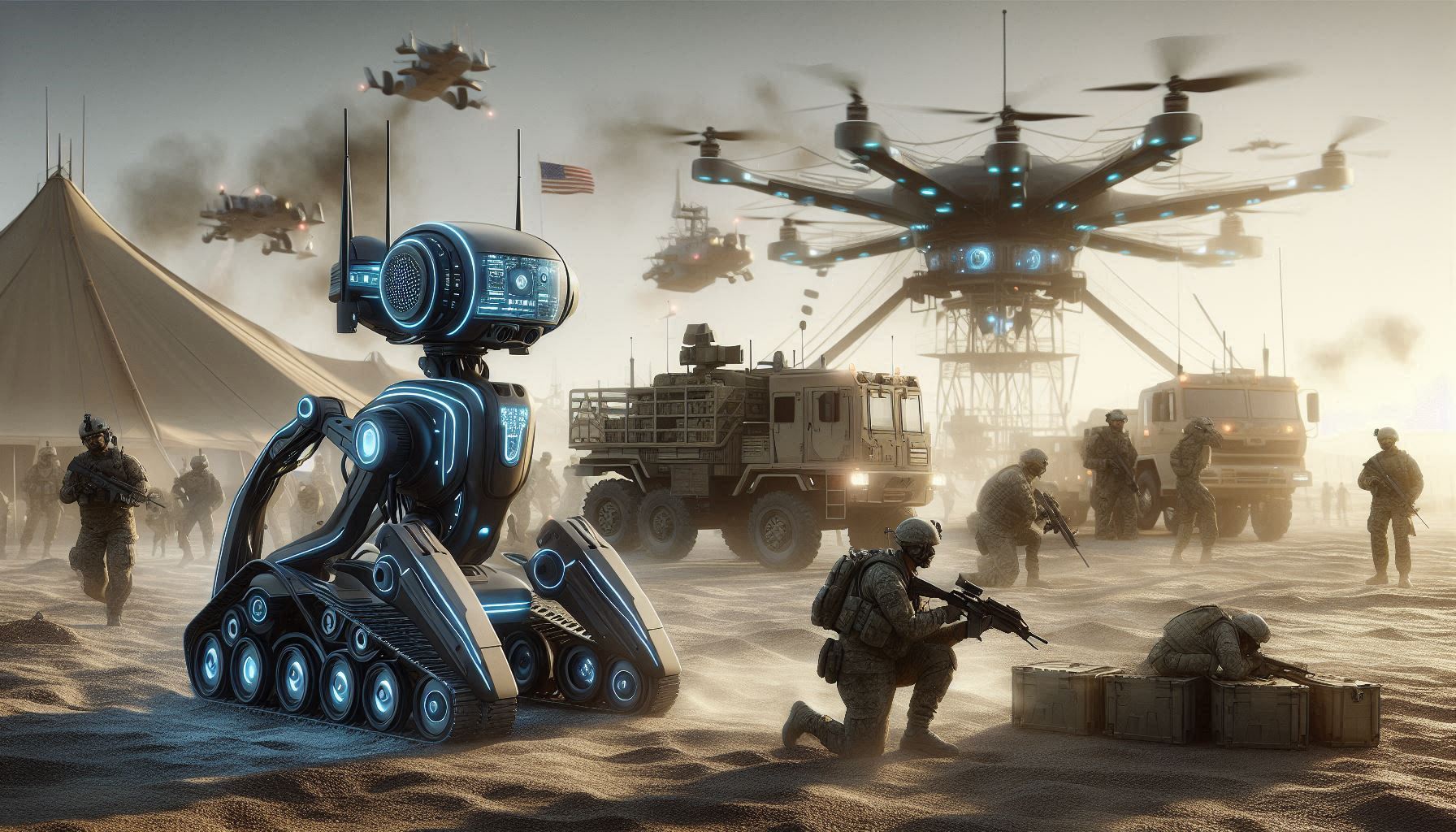
Modern warfare is quietly shifting into a phase where command is no longer defined by who sees the battlefield, but by who can understand it first.
AI-augmented Command and Control systems, often called C2 systems, are becoming the central nervous system of modern defense operations. At the core of this transformation is a simple but powerful reality: the battlefield now produces more data than any human staff can process in real time. Satellites, drones, ground sensors, naval systems, cyber feeds, and intelligence reports generate continuous streams of fragmented signals. The challenge is no longer collecting information. It is making sense of it fast enough to act.
This is where AI-driven command systems are changing the structure of military decision-making.
In today’s most advanced defense networks, AI is being used to merge all operational data into a single, constantly updated picture of the battlefield. Systems inspired by programs like the Maven Smart System are already deployed across NATO structures, where they support commanders by fusing satellite imagery, drone surveillance, radar inputs, and intelligence reports into one operational view of the environment.
What makes this shift significant is not just speed, but coherence. Traditionally, military command centers rely on layers of analysts, officers, and communication channels to build a shared understanding of the battlefield. Each layer adds delay, interpretation, and sometimes contradiction. AI changes that structure by collapsing those layers into a unified analytical flow, where raw data is continuously interpreted, filtered, and presented as actionable insight.
Inside modern command centers, this looks less like a traditional war room and more like a living system. Large displays no longer show static maps. They show evolving environments. Threat indicators move in real time. Units update automatically. Risk zones shift as new intelligence arrives. The system does not just display information. It continuously reconstructs reality as new signals enter the network.
One of the most important developments in this space is the integration of AI into what militaries call the decision cycle. The cycle includes sensing, processing, understanding, planning, and action. In earlier eras, this cycle could take hours or even days. In high-intensity conflict, it is now compressed into minutes.
AI systems support this compression by doing something humans struggle with under pressure: filtering signal from noise. On a modern battlefield, thousands of data points may arrive simultaneously. Most are irrelevant. Some are misleading. A small fraction represents real threats. AI models are trained to detect patterns across this chaos, identifying anomalies, tracking movement changes, and highlighting probable risks before they become visible through traditional analysis.
Recent military exercises and operational deployments have shown how AI can accelerate decision-making by turning overwhelming data streams into structured intelligence for commanders at every level.
But the real transformation is deeper than efficiency.
Command and Control systems are evolving into distributed intelligence networks. Instead of a single headquarters attempting to interpret everything, AI enables shared situational awareness across multiple command levels simultaneously. A commander at the tactical edge can see a filtered version of the same operational picture as a strategic headquarters, adapted to their role and mission. This reduces fragmentation and improves coordination across complex operations involving land, air, sea, space, and cyber domains.
At the center of this architecture are AI fusion engines. These systems ingest multiple streams of intelligence and continuously reconcile contradictions. A drone may detect movement in one area, while satellite imagery shows no activity. Signals intelligence may suggest electronic interference. AI does not simply choose one source. It builds a probabilistic model of what is most likely happening, updating it as new data arrives.
This ability to continuously revise understanding is what makes modern AI-enabled command systems fundamentally different from earlier digital tools. They are not static dashboards. They are adaptive systems that refine their own interpretation of reality.
Another emerging dimension is predictive command support. Instead of only describing what is happening, AI systems are beginning to estimate what may happen next. This includes forecasting movement patterns, identifying likely escalation points, and simulating multiple operational scenarios in parallel. These simulations allow commanders to evaluate outcomes before committing forces, reducing uncertainty in high-risk environments.
The goal is not to replace human command. In every major deployment, human authority remains central. But the role of the commander is shifting from direct processor of information to final decision authority within an AI-structured environment. The system does the heavy cognitive lifting. The human provides judgment, intent, and accountability.
This shift is already visible in NATO’s broader modernization efforts, where AI-enabled warfighting platforms are being integrated into Allied Command Operations to improve battlespace awareness and accelerate operational planning.
As these systems evolve, they also reshape the nature of military advantage. In the past, superiority came from numbers, positioning, or firepower. Increasingly, it comes from decision speed and information dominance. The side that can process reality faster gains the ability to act before the opponent has fully understood what is happening.
This introduces a new strategic layer: the speed gap between sensing and acting. AI reduces that gap dramatically. But it also raises new challenges. Systems become more dependent on data quality, network integrity, and algorithmic reliability. A corrupted input or misleading signal can propagate quickly through the entire decision chain if not properly checked.
Because of this, modern C2 systems are being designed with redundancy and human oversight embedded into every layer. AI suggests, but does not autonomously decide lethal action. Human operators remain the final checkpoint in critical decisions. This balance is considered essential to maintaining control in environments where uncertainty and deception are constant.
What is emerging is not a fully autonomous battlefield, but something more complex: a hybrid intelligence environment where humans and machines operate as a single decision ecosystem.
In this ecosystem, AI handles scale, speed, and pattern recognition. Humans handle intent, ethics, and strategic direction. The combination creates a new form of command capability that is faster than traditional systems but still anchored in human judgment.
The direction of travel is clear. Future defense operations will not be defined by isolated technologies, but by integrated intelligence layers that connect sensing, analysis, and command into a continuous loop. The battlefield will become increasingly transparent to those with advanced AI systems, while remaining fragmented and ambiguous to those without them.
In that world, command is no longer just about issuing orders. It becomes about shaping systems that can understand, anticipate, and respond to complexity faster than it unfolds.
And that is where AI-augmented Command and Control is quietly redefining the next generation of defense.