

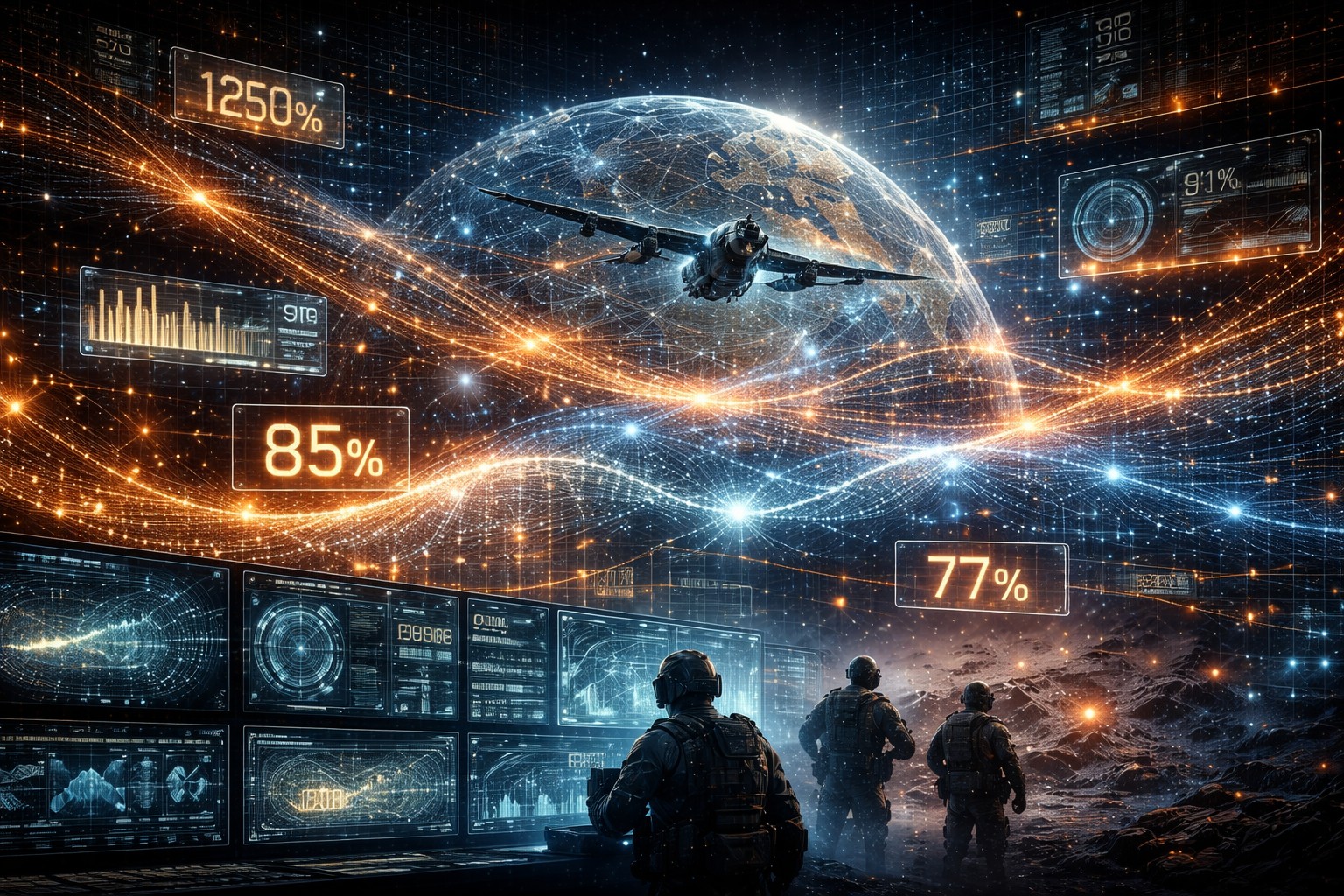

There is a growing gap between how war is discussed and how it is actually being fought.
Public discourse still frames artificial intelligence as a future capability. Policy circles debate ethics, governance, and long-term frameworks. Committees are formed. Reports are drafted. Timelines stretch across years.
But the data shows something very different. Artificial intelligence is no longer being prepared for war. It is already embedded inside it.
By 2023, approximately 85 percent of U.S. Department of Defense AI projects had already transitioned into operational use.
This is not experimentation. It is deployment.
Across NATO, 77 percent of member states are already training troops to operate with AI systems, and 84 percent of commanders have received AI-related training.
The shift is not theoretical. It is institutional.
The integration runs deeper than most people assume. In the United Kingdom, AI is already used in around 55 percent of RAF intelligence, surveillance, and reconnaissance missions. In multiple countries, AI is now embedded in targeting systems, logistics, cyber operations, and battlefield awareness.
This changes something fundamental.
War is no longer a sequence of human decisions supported by machines. It is increasingly a system where machines compress time, filter reality, and shape decisions before humans fully understand the situation.
The Compression of Time
The most important shift is not autonomy. It is speed.
Artificial intelligence collapses the cycle between:
- detection
- analysis
- decision
- action
Processes that once took hours or days are now executed in minutes or seconds.
This is not a marginal advantage. It is a structural one. When NATO acquired an AI-enabled battlefield system, the procurement cycle took roughly six months from requirement to acquisition, with deployment expected within weeks.
Compare that to traditional defense timelines, where capability development often takes years. The implication is simple.
The side that shortens time wins before the other side even reacts.
The Quiet Shift of Decision-Making
There is another shift that is less visible but more consequential. A 2023 survey showed that 91 percent of military generals expect AI to play a direct role in decision-making within five years.
This is not about automation of tasks. It is about delegation of cognition.
AI systems are already:
- prioritizing targets
- filtering intelligence streams
- generating operational recommendations
In controlled experiments, AI-assisted intelligence analysis produced faster and more accurate assessments under time pressure than human-only teams, even though human confidence in those decisions did not increase.
This creates a new type of battlefield condition. Humans are no longer the primary processors of information. They are becoming supervisors of systems that interpret reality first.
The War Most People Do Not See
Much of this transformation is invisible. Modern military AI is not primarily about autonomous weapons. It is about:
- intelligence fusion
- surveillance and targeting
- cyber operations
- information warfare
Research shows that current AI deployment is already deeply embedded in intelligence, surveillance, target acquisition, and reconnaissance systems, which are central to real-world military operations. At the same time, AI is expanding into influence operations.
NATO itself has warned that AI-driven disinformation can:
- destabilize societies
- erode trust in institutions
- influence political outcomes during conflict
This means the battlefield is no longer just physical.
It exists in data, perception, and decision-making environments that most policymakers do not fully understand.
The Private Sector Is Now Part of the War Machine
Another reality that remains underappreciated is where this capability is coming from.
The acceleration of military AI is increasingly driven by private companies.
In 2026, a single defense AI company, Shield AI, reached a $12.7 billion valuation, driven by demand for autonomous military systems already integrated into platforms like fighter jets.
At the same time:
- commercial AI tools are being integrated into defense workflows
- technology firms are partnering directly with military organizations
- civilian and military data ecosystems are merging
This is not a traditional defense model. Innovation is no longer controlled by governments. It is emerging from ecosystems that move faster than state institutions can regulate.
The Illusion of Control
Despite all of this, much of the global response remains procedural.
Governments continue to:
- draft ethical frameworks
- establish oversight bodies
- debate responsible use principles
These efforts are necessary. But they are also slow.
Meanwhile, AI systems are already shaping:
- how wars are fought
- how decisions are made
- how outcomes are determined
The gap is no longer about technology.
It is about mindset.
What the US and Iran Tension Reveals
Recent tensions between major powers highlight a critical misunderstanding.
Superiority in resources or technology does not guarantee control.
What matters is:
- how quickly systems adapt
- how effectively signals are interpreted
- how decisions are made under uncertainty
AI changes all three. The advantage no longer belongs to the actor with the most power. It belongs to the actor that understands what is happening before it becomes visible.
The Real Divide
The world is now splitting into two types of actors:
- Those who believe they understand the system
- Those who are constantly updating their understanding of it
The first group builds committees.
The second builds systems.
The Future Does Not Belong to Certainty
There is a persistent belief that dominance comes from knowing more.
In reality, modern conflict shows the opposite.
The future belongs to those who:
- anticipate what could happen
- adapt to what is happening
- and operate without relying on fixed assumptions
Artificial intelligence does not remove uncertainty.
It accelerates it. And in that environment, the most dangerous position is not being behind. It is believing you are ahead when you are not.
Final Thought
The AI war will not be declared.
There will be no clear starting point.
No single moment where the world recognizes that everything has changed.
Because by the time it becomes obvious, the outcome will already be shaped.
And most countries will still be in meetings.